Showed this to Cheryl yesterday. We've resolved to do more of what's recommended. We've both gotten too sedentary owing to our work ("Sitting is the new Smoking").
__
LEADERSHIP
Below: a personal focus of mine at IHI 25, notwithstanding my intense interest in so many of the enticing yet too-many-to-cover tech sessions:


In healthcare (albeit -- to be fair -- as is the case with enterprise more broadly), we love our totemic cliches. "Leadership" is too often one of them.

At my last place of employ we had a group of managers (HIT, HIE, and the ED) who summarily declared themselves "Leadership."
A noun. The Department of Leadership, I guess. The Ministry of Leadership.

They spent most of their time closeted away in lengthy hush-hush, FUD angst-incubating closed-doors meetings, emerging episodically to announce their latest summary edicts.
A particularly grating pronouncement to me was an emphatic and curt declaration one day by one of them during staff meeting: "now that Leadership has decided [regarding an as-yet truly operationally unresolved issue], discussion is over."
Okee-dokee. Irony-Free Zone, much?
This increasingly autocratic attitude was one factor in my decision to retire, quite frankly.


So, "Leadership." What of it?
Google it.


107,615 hits just in the "books" category. My fiscally-enervating Whispernet 1-click strikes yet again, twice more.

I'd noticed these in the IHI 25 Forum bookstore. Snapped cover photos in my iPhone so I could review them on Amazon (the bookstore clerk was not amused). I've downloaded and just started them. (Uh, there's that equally dubiety-inducing word "Transforming").
MacCoby's work certainly looks intriguing.
PREFACE
Who’s a Leader?Interesting. I've read and have long cited Gardener's "Changing Minds," but mostly in the context of the issues and tactical elements of persuasion, i.e., "influence" (Robert Cialdini's Influence: The Psychology of Persuasion is also compactly and effectively instructive in this regard).
THE NEED FOR LEADERS is urgent—to mobilize human intelligence and energy to grapple with historic threats such as global warming and weapons of mass destruction, and also to respond to vast opportunities to improve life on this planet. Only effective political leadership can show the way to achieve health care for all Americans, to gain energy independence through alternative nonpolluting technologies, or to fix public education so that it prepares children of every background for a demanding global economy. Only a persuasive national leader can gain support at home and abroad for policies that protect our society from its enemies. Only exceptional business and organizational leaders can provide employment and produce the goods and services essential for a strong economy. Yet despite the thousands of books and articles on the subject, we haven’t improved on classic writings about leadership. To start with, even the best recent writers on leadership stumble over the definition of a leader, and a good definition is the beginning of understanding the kinds of leaders we need and how they’ll gain followers in the context of our time.
John Gardner, a former secretary of Health and Human Services and noted leadership thinker, described very well what bureaucratic leaders do, but like a number of writers on the subject, his definition is inadequate. He defines a leader in terms of tasks: setting goals, motivating people, evaluating them. This definition doesn’t distinguish a leader from a manager or even from some leaderless teams that set their own goals and motivate each other. Other writers tell us the defining task of a leader is visioning. Certainly, many leaders have been visionaries, but lots of people with visions have no followers; some of them have ended up isolated—and even in mental hospitals.
James McGregor Burns’s brilliant treatise on leadership is full of rich historical vignettes. Burns has given us the useful distinction of transactional versus transformational leaders. By his definition, a transformational leader raises people to higher moral levels, changing them in a positive way. But this definition implies that monsters like Hitler, Stalin, and Mao weren’t transformational leaders—even though millions of people worshipped them and millions were changed by them, mostly for the worse. Even if a leader is just defined as someone who gets people to change, this wouldn’t distinguish a leader from a manager who shakes up an organization by redesigning roles and incentives. It wouldn’t even distinguish a leader from a skillful psychotherapist.
There is only one irrefutable definition of a leader, and that is someone people follow. This may seem too simple a definition for many academics, but once accepted it opens the door for plenty of hard thinking. Once we agree that anyone with followers—liberator or oppressor, transformational visionary or transactional problem solver—is a leader, then we have to answer two difficult, essential questions about leadership...
MacCoby, Michael (2007-10-04). The Leaders We Need: And What Makes Us Follow . Harvard Business Review Press. Kindle Edition.
So, persuasiveness cannot but be a core element of leadership, but what else?
I went to the day-long IHI pre-conference "Leadership Required for the New Era" for some timely and useful insights.
From their just-released White Paper:

Executive Summary
There is solid evidence that leadership engagement and focus drives improvements in health care quality and reduces patient harm. Leaders at all levels in care delivery organizations are struggling with how to focus their leadership efforts and achieve Triple Aim results for the populations they serve. Triple Aim results represent the shift from volume to value, which demands that health care leadership at every level of care delivery organizations focus on improving the experience and outcomes of care provided and reducing the cost of care for the populations they serve.
High-impact leadership is required to achieve Triple Aim results. To that end, this white paper presents three interdependent dimensions of leadership: new mental models, High-Impact Leadership Behaviors, and the IHI High-Impact Leadership Framework.
New Mental Models for Health Care Leadership
Mental models — how leaders think and view the world — are critically important because how leaders think and what they believe shapes their leadership behaviors and provides direction to focus their leadership efforts in transforming from volume-based to value-based care delivery systems. High-impact leadership requires leaders to adopt four new mental models: 1) individuals and families are partners in their care; 2) compete on value, with continuous reduction in operating cost; 3) reorganize services to align with new payment systems; and 4) everyone is an improver.
With these new mental models providing context, leaders shift the way they define success, considering new approaches and mobilizing their staff to adapt to the continually changing business environment. New mental models promote innovation.
High-Impact Leadership Behaviors
Our premise is that certain High-Impact Leadership Behaviors and practices are tightly aligned with the mental models and the leadership framework. Our list of five critical behaviors is intended to be open-ended — the starting point for health care leaders to thoughtfully examine their own leadership practices, and how they might align those behaviors with their leadership efforts and strategies to produce Triple Aim results.
- Person-centeredness: Be consistently person-centered in word and deed
- Front Line Engagement: Be a regular, authentic presence at the front line and a visible champion of improvement
- Relentless Focus: Remain focused on the vision and strategy
- Transparency: Require transparency about results, progress, aims, and defects
- Boundarilessness: Encourage and practice systems thinking and collaboration across boundaries...
Conclusion
High-impact leadership is not just for senior leaders, but is required at every level of care delivery organizations in order to deliver Triple Aim results. Value-driven, high-reliability health care sustained by improvement and innovation requires leaders at all levels to think with new mental models about the challenges and their role, practice cross-cutting High-Impact Leadership Behaviors, and focus their leadership actions through the lens of the IHI High-Impact Leadership Framework to achieve Triple Aim results for the populations they serve.
Over the past 25 years of experience and observation, IHI developed key concepts and an approach to leadership for improvement and innovation in health care. Building on this foundation, three interdependent dimensions of leadership have now been incorporated into an approach for focusing and organizing leadership efforts for leading improvement and innovation: new mental models, High-Impact Leadership Behaviors, and the IHI High-Impact Leadership Framework. The framework explicitly addresses three new areas of required leadership efforts and actions: driven by persons and community; shape desired organizational culture; and engage across traditional boundaries of health care systems.
The High-Impact Leadership Behaviors, required for leaders throughout the organization, have thus far been implemented and found effective for a group of leaders, both in and outside the health care industry. Time and experience will show if adopting new mental models and these specific behaviors will continue to magnify leaders’ effectiveness as they take on the challenges in the changing health care environment. The goal now is to provide an even larger group of leaders with the most direct path to a more person- and community-centered, effective, and agile organization. In short, there is much to be learned.Have to say, this trio of IHI presenters were quite thorough and astute. A day well spent. Much to yet ponder and assimilate.
We invite organizations to test, adapt, and share the models, behaviors, and framework offered in this white paper. As with previous frameworks, this one will benefit from learning and feedback, and IHI intends to harvest and improve on the ideas and concepts with the community of leaders. We invite feedback on what is helpful, what is missing, and what are the next steps for building strong leadership and more reliable improvement in patient experience, cost of care, and population health.
Below, one of my favorite quotes, from way back during my time in IHC healthcare QI training.

I've never really thought of myself as a "leader." And I've never had any interest in its red-headed stepchild the "manager." My skills and interests are primarily technical and creative.
Uh, well, much like the necessary skill sets of the physician, I guess (though nowhere near in degree).
I did, however, spend a good number of my working musician years being a pretty good bandleader (adroitly herding "cats" and drawing out their talents), and -- if I may be so bold -- I was a pretty adept university "chalk talk" classroom and grad seminar teacher for a while (it was great fun). So I think I have some decent persuasive skills.
But, durably effective Leadership in the fractious arena of the healthcare space requires much more finely honed, broad and deep skills -- abilities irreducibly riding atop a solid foundation of empathic "authenticity" (points 1 and 2 above).
More on this as my study continues and my thinking clarifies. Below, from a tweet during the Forum:

Indeed. I've been having some email discussions of late with some national nursing leaders about the patient safety implications of the adversarial, dysfunctional management cultures far too prevalent in healthcare, where one speaks truth to power at one's peril.
I've worked in about seven or eight different organizational settings across the span of my white collar career. Only one of them could be considered a "safe," non-toxic culture (somewhat ironically, a hardhat clientele digital industrial diagnostics company in West Knoxville, TN, where I was a writer and our Technical Editor). The rest were burdened by differing degrees of authoritarianism, back-stabbing, and org chart climbing machinations.
It remains a problem. One all the more ironic in the "health" domain. If you work in healthcare, you know exactly to what I'm referring.
From Transforming Health Care Leadership:
The Role of Culture In most medical schools, physicians are selected and trained to be autonomous craftsmen. There is little teaching about interdependence, leadership, or the importance of organization. Physicians are not trained to look at work from the viewpoint of nurses, psychologists, pharmacists, technicians, or even patients. The image of the independent decision maker that may have made the field attractive to them is reinforced by their education. Expert physicians are comfortable within a craft mode of production. Their ideal organization is their own craft shop or possibly a partnership...
No longer will patients passively wait for the health care community to tell them what to do. Their expectations are challenging the existing health care delivery systems, health care professionals, and information systems. The ability of patients to evaluate their conditions, care, and options via the Internet challenges traditional relationships, craft- and production-oriented health care systems, and their providers. Partnering and the integration of informed patients and patient advocates into the delivery system will differentiate health care organizations as they transform into the interactive health care learning environment of the future.
Physicians have run clinics or their own medical offices. Yet their education does not include courses to help them manage and improve complex health care organizations, much less lead others to do so. If physicians and nurses are to lead learning organizations, they must develop new skills and knowledge.
There is resistance to change, particularly from physicians whose social character and training support the craft mode of production. Unless the education of physicians focuses on developing the values and competencies for a learning organization, resistance will continue to impede positive change. However, we met many younger physicians with a more interactive social character who respond in a more positive way to a learning organization (see Chapter 8). Nurses are often the behind-the-scenes leaders within clinics, wards, and offices, running the business and managing patient care. They work in partnership with physicians, specialists, administrators, and other nurses. Many times they defer to the physician or manager in charge. They generally choose not to lead, even when they understand better than formal authority figures the personalities and viewpoints of physicians, nurses, and other professionals and patients. They tend to defer to the physician as the leader. They need to develop leadership competence and confidence. Leadership in learning organizations should be based on knowledge and leadership qualities, not professional affiliation. All health care workers should be respected for their distinctive competences.
Health care organizations are cultures or social systems that have purposes and are composed of people who must be motivated to achieve these purposes. These cultures differ according to their social, political, and business environments and traditions as well as their missions. They select and socialize different values in their key members. Social systems will learn and develop only when leaders align innovations with other elements of the system. Otherwise, new ideas and approaches will be limited, distorted, or totally rejected. The good news is that some of the leaders of health care organizations are becoming aware of what is required to transform their systems, and they are providing models that others can learn from, but not necessarily copy. Adaptation and testing to fit local circumstances are critical to successful implementation.
Leaders of some of the best health care organizations in the United States, Canada, United Kingdom, Sweden, and other countries strongly affirm the need to move to the learning mode of production. Elements of the learning mode are emerging in some of these organizations, but creating a learning organization requires leadership and continual development.
Policymakers should understand that solving the problems of health care delivery is not just a matter of adopting new policies and incentives, but rather of transforming a craft mode of production in a way that incorporates the best craft values into more productive, interactive learning organizations.
Leaders for health care organizations should be selected not because they are distinguished experts, but because they demonstrate strategic intelligence and understand the logic of business, quality, and leadership. They must gain the informed support of their boards, recognizing that even positive change will provoke resistance...Interesting observation about nurses. Very interesting.
More MacCoby:
Without effective leaders, health care organizations will not become learning organizations. Leaders are needed to protect the best qualities of caring and service found in the craft tradition of medicine and nursing and also build on them to establish new ways of working. With the active participation of staff, leaders are needed to continuously improve patient safety and outcomes, reduce unnecessary costs, enhance patients’experience of service, and improve population health. Above all, leaders are needed to encourage the doubters, to infuse the belief that the people can create the organization's future...
What is leadership? Leaders are people others follow. If no one follows you, you are not a leader. If you have followers, you are a leader. Leadership is a relationship. Good leadership means people willingly follow a leader who is working to further the common good, the well-being of all stakeholders. Good leaders make followers into collaborators. Leadership implies a relationship that cannot be handed off to anyone else. In contrast, management is a collection of functions. Management has to do with measurements, monitoring, HR, supply functions, and the implementation of service delivery necessary for operations. Many management functions do not require managers as teams can share these functions, even rotate them within a team, and some can be automated. Both leadership and management are necessary for the success of organizations. All managers should be leaders, and in fact, most can be developed for leadership roles. As the Institute of Medicine recommends, a continuously learning health care system requires “broad leadership.”...
Maccoby, Michael; Norman, Clifford L.; Norman, C. Jane; Margolies, Richard (2013-07-29). Transforming Health Care Leadership: A Systems Guide to Improve Patient Care, Decrease Costs, and Improve Population Health (Kindle Locations 1193-1200). Wiley. Kindle Edition.

We can tie some of this stuff back around to Julie Winkle Giulioni's fine book "Help Them Grow or Watch Them Go."
Curiosity might be the most under-the-radar and undervalued leadership competency in business today. Think about it: what could you accomplish if you practiced passionate listening— really listening with intention and a true sense of purpose to learn and understand? What ideas and possibilities could you cultivate if you honed your ability to wonder out loud with those around you?
Developing the ability to approach individuals, situations, and conversations with curiosity and even a sense of wonder can affect your own energy and enthusiasm, relationships with others, and hard business results— not to mention the quality of your career conversations.
Quality questions asked without curiosity will signal to employees that you’ve just come back from training.
Quality questions asked with the spirit of curiosity will facilitate conversations that will literally allow others to change their lives.
CLOSURE IS OVERRATED
Given this focus on asking questions, it bears repeating that you don’t have to have all the answers. Neither does the employee, for that matter. In fact, not having all the answers may actually drive more thought and energy.
According to Russian psychologist Bluma Zeigarnik (in “The Retention of Completed and Uncompleted Actions,” which appeared in Psychological Research in 1927), we remember better what’s incomplete. The problem is that this lack of closure generates an internal tension for many. The mind, uncomfortable with what has been left unfinished, continues to focus on the question or problem.
So, what does this science have to do with helping your people grow? Many managers shy away from hard questions and conversations where they might not have all the answers. If you’re one of them, you don’t have to do that any longer. Quite the opposite. Go ahead and courageously ask the challenging questions and even end the conversation with a real tough or thought-provoking one that the employee can contemplate for a while.
Don’t feel the pressure to wrap up every conversation with a bow.
Kaye, Beverly; Winkle Giulioni, Julie (2012-09-17). Help Them Grow or Watch Them Go: Career Conversations Employees Want (BK Business) (pp. 23-24). Berrett-Koehler Publishers. Kindle Edition.Indeed. John Toussaint added an "8th waste" to the traditional "7 wastes" of Lean theory -- the waste of unused talent.

ADDITIONAL RANDOM SHOTS FROM A GREAT IHI 25 HANG


 |
| These kids were off-the-hook fine. Their National Anthem rendition gave me chills. |


 |
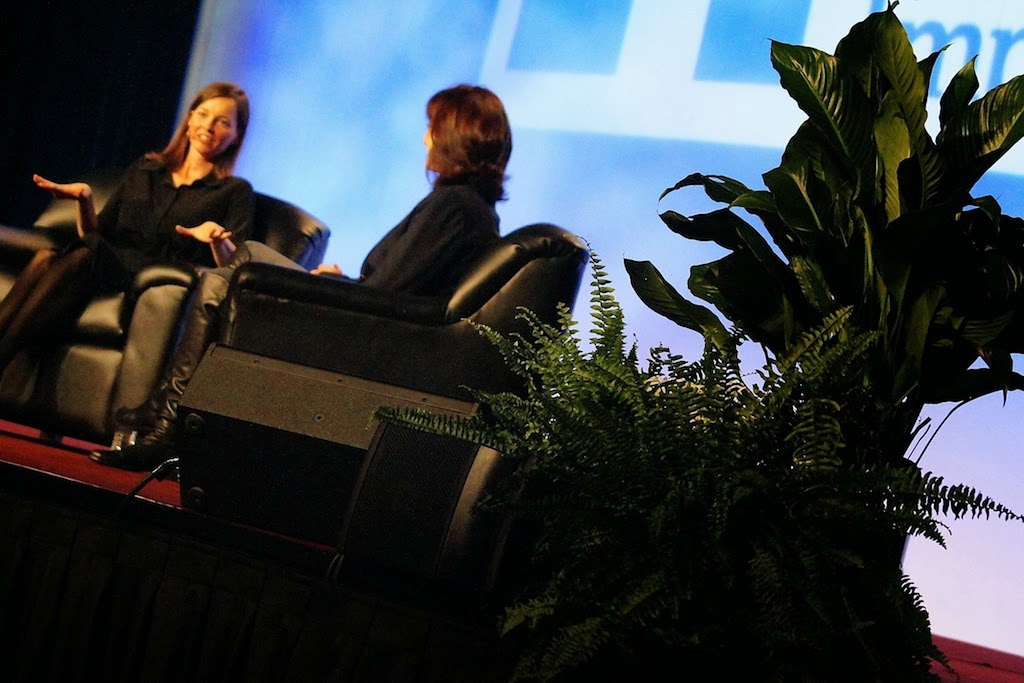
| Decent lighting, except in the various session rooms, wherein most of the presenters were literally in the dark. Learn from Health 2.0, folks, it's a live presentation, make it uniformly vibrant. |

 |
| The fabulous Dr. Mark Smith of CHCF. |

 |
| IHI CEO Maureen Bisognano during her Keynote on "flipping education and healthcare" |


 |
| Leana Wen, MD. I'm currently reading her book |

 |
| Glad to see a bit of benign neglect of healthy snacking. There was no half & half at the Health 2.0 conferences, just yucky soy and rice milk. |

 |
| The box lunches were really fine, but baked potato chips are a solution in search of a problem. Like eating lightly salted drywall flakes. |


 |
| The poster session hall was huge. A forest of great infographics. |


ERRATUM
The future of Obstetrics?

JUST IN: SAVE THE DATES

I will be there. Register here.
CODA
The Wall Street Journal asked yesterday for permission to use one of my HIMSS13 shots of Dr. Mostashari. Granted.


Nice. WSJ content is firewalled, but, try the link anyway.
___
More to come...