Friday, January 17, 2014

Meaningful Use Stage 2 is off to a bumpy start

As reported on MedPage Today
Few Docs Ready for Stage 2 'Meaningful Use'
Jan 17, 2014, David Pittman, Washington Correspondent, MedPage Today

WASHINGTON -- Roughly one physician in eight has an electronic health record (EHR) system capable of supporting most requirements for Stage 2 of the "meaningful use" program, a government survey found.

Only 13% of office-based physicians reported an intention to participate in the EHR incentive program and had a system meeting 14 of the 17 Stage 2 core objectives, according to a report released this week from the CDC's National Center for Health Statistics (NCHS).

About 56% of all physicians intended to participate in the EHR incentive program but didn't meet the core objectives the NCHS asked about.

"Meaningful use" refers to provisions in the 2009 Health Information Technology for Economic and Clinical Health (HITECH) Act, which authorized incentive payments through Medicare and Medicaid to clinicians and hospitals that use electronic health records in a meaningful way that significantly improves clinical care...

Over on THCB, Incoming ONC head Dr. Karen DeSalvo tried to put a positive spin on the state of health IT in her recent piece Survey Says: EHR Incentive Program Is on Track. Be interesting to hear what she has to say next week at the ONC Annual Conference in DC.

Below, the typical invective hurled by the anti-HIT trolls, this one from Dr. DeSalvo's post.


NEVADA HIE UPDATE

Sources tell me that the ONC funded Nevada State HIE (run out of DHHS, not HealtHIEnevada.org) may be about to fail. It won't be the first one, but it will sure be another multi-million dollar waste of taxpayer money.

Speaking of wasting money:

__

MONDAY MORNING UPDATE (JAN 20TH)
Do providers have the EHRs for Stage 2 Meaningful Use?
Jennifer Bresnick, January 20, 2014


Providers may be lacking one big, basic ingredient for a successful Stage 2 attestation: a certified EHR capable of meeting the Meaningful Use objectives.  The National Center for Health Statistics (NCHS) has released a new data brief that highlights the relatively small number of providers operating on an updated EHR as the industry enters the second stage of the EHR Incentive Programs.

While 69% of office-based physicians reported that they intended to participate in meaningful use during a survey in 2013, only 13% of those providers also had an EHR system capable of supporting 14 of the Stage 2 core and menu objectives.  While this number seems exceedingly low, one should note that the survey was conducted between February and June of 2013, long before the majority of EHR vendors had even finished developing their 2014 ONC certified technology.

However, it is no secret that it’s been an achingly slow process to get the new technology through the testing and verification process.  Tight deadlines and major upgrades are slowing the adoption process for providers who have already spent big bucks on their 2011 systems...

Were I a Medicare EP who began attestation in 2011, I'd have by now collected $38k of the full $44k incentive reimbursement potential (not counting the sequester deduction now applied to the payments), ~86% of the total available. It sure looks to me that the combination of costs for Stage 2 upgrades -- certified software update, workflow alterations, administrative expenses -- may well eclipse any remaining potential reimbursements.

A doc I know responds:


__

And the hits just keep on coming...
Why specialists don’t like their EHRs

The list of reasons why specialists don’t like their EHRs could go on for pages, but what it really comes down to is this: most EHRs try to satisfy everyone’s needs, an impossible feat in a world with hundreds of medical specialties. Hospitals and primary care practices can sometimes make a one-size-fits-all EHR work, but specialists have a much harder time adjusting to having an EHR as part of their workflow.

A recent Black Book Rankings survey found that specialists are much less happy with their current EHR than family physicians are. However, most physicians place the blame on themselves. The top three reasons for considering a vendor switch all have to do with picking the right EHR:

  1. Solution does not meet the individual needs of the practice, including workflow (80 percent)
  2. The practice did not adequately assess its needs before selecting the original EHR (79 percent)
  3. Design of EHR is not suited for the practice specialty (77 percent)
Moving forward, specialists are taking a lot more care in picking their next EHR, focusing on more than just qualifying for government incentives. According to Black Book, here are the top five “must haves” for a replacement EHR vendor:
  1. Vendor viability (84 percent)
  2. Provider data integration and network data sharing (83 percent)
  3. Demonstrable return on investment (78 percent)
  4. Adoption of mobile devices (75 percent)
  5. HIE support and interoperability
With the EHR market in a constant state of shuffling out the unpopular EHRs, practices are most concerned with an EHR’s past success and future prospects. Practices want proof now, not just promises...
___

More to come...

Monday, January 13, 2014

Next up...


Register here. An important two days via which to get a sense of just where the federal Health IT effort is headed and what progress might be expected. Incoming ONC head Dr. Karen DeSalvo certainly has her work cut out for her.

Then, in February,


Register here.

Former President Bill Clinton keynoted last year at HIMSS13 in NOLA. It was fabulous.
__

A DOCTOR DEFENDS HIS EMR

I spend a lot of time online defending health IT from the large contingent of irascible Perfectionism Fallacy naysayers. I get called a "troll," a "EHR Vendor shill," and told I have no right to even opine because I'm not a physician.

Well, this man is a physician:
...Modify my note with today’s findings and conclusions.  Write, in the computer, any new orders.  The orders are instantly checked for allergies, compatibility, dose, availability, redundancy and communicated to the proper department.  Complete.  Legible. Efficient. Accessible and transmittable (via encrypted form).  Even fun.

The quality of medical care because of clarity, accuracy, speed and the quality of communication is multiplied, probably exponentially. Problems are not forgotten. Errors are quickly identified. The valuable efforts of patient and professional are not wasted.  The time needed to create extraordinary medical records is cut at least in half.  The medical record is not just another device, like a pencil, tape measure or paper chart. It is a tool to guarantee, amplify and create quality.


Is the future here?  Are present day EMRs the Holy Grail?  Not yet. They still have major problems in data input, across system compatibility and universal access. However, they a stunning technology that saves cost not only by saving time, but by improving the quality of the record and therefore the quality of care.  In the future, not to far away, EMRs will interface with medical information and research databases and work with each doctor with each patient on each day to assure the most accurate diagnoses, the best treatment and the best chance of cure.  Even now, they are revolutionary...
From The Health Care Blog.
__

TUESDAY, JANUARY 14TH, MY "EPIC" DAY

Had my initial visit with my new Primary, in the brand-new John Muir Medical Group facility in Walnut Creek. They provide a pretty nice patient portal. I was able to go in ahead of time and start populating some data.


I got there at 7:30 a.m. Everyone was all spiffed out, cherubic, effusively solicitous. This was opening day for the new complex at 1450 Treat Blvd. The place is beautiful. Registration was a breeze, both in the expansive downstairs foyer and up at outpatient internal med in suite 250.

Free patient Wi-Fi. I'd brought my Mac Air, just in case I had any extended wait time. Nice.

Muir uses EPIC. There were bugs. The M.A. doing my vitals and CC, etc. Had trouble logging into the large wall-mounted terminal in the exam room. Had to make a tech support call. I don't like the wall terminal thing. That is so yesterday.

My new doc came in, sporting a laptop. Along with him came an IT dude.

EPIC support. It was needed. I bit weird, being worked up and examined by my new doctor with this IT guy in the room.

Nonetheless, we hit it off. Young doc, a D.O. (I'd weighed the relative merits of going with someone closed to my age). I told them I did Health IT journalism and gave them each my card. The doc kept anxiously apologizing for any glitches in this initial encounter. It'll be big-time shakeout cruise this week for them, I'm sure.

No problem. I'd used the portal internal email a head of time to send him a PDF of my last complete progress note dump from Dr. Gong's Encounter Pro EHR in Vegas (my prior Primary).

He'd not yet seen it.

He told me they'd immediately eRx my two maintenance meds renewals to Walgreens close to the house where I've been getting my scrips, and he wrote me a lab order for fasting bloodwork.

Later in the day I got a call from Dr. Gong's office, telling my they'd gotten a renewal request they couldn't fill because I was overdue for my latest f/up visit.

"Look, I called you in December advising that I'd moved to the Bay Area and was looking for a new Primary, and would like Robert to give me any referrals he could."

Never heard back.

So, now I gotta get in someone's face at Walgreens here to straighten out the eRx mistake.

An "EPIC" day. I really like this new doc. We'll see how my experience with Muir goes.

A COUPLE OF MILESTONES


+200k blog hits, +1,000 Twitter followers. Just keep plugging away.
__

MEANINGFUL USE INCENTIVES PAYMENTS UPDATE
Meaningful Use Incentive Payments Reach Nearly $18 Billion, CMS Says
January 15, 2014, Alex Ruoff 

Jan. 14 --The Centers for Medicare & Medicaid Services has issued nearly $18 billion in Medicare and Medicaid incentive payments through its meaningful use program, a CMS official said Jan. 14.

As of November 2013, the CMS had paid 334,081 hospitals and health-care providers more than $17.77 billion in incentive payments to adopt electronic health record systems, Robert Anthony, an eHealth specialist for the CMS, said at a meeting of the Health IT Policy Committee.

Although registration with the meaningful use program slowed slightly in November and December, Anthony said, it remains a widely popular program.

More than 93 percent of all hospitals eligible to receive an incentive payment through the meaningful use program had registered for a payment by November. More than 80 percent of all health-care providers eligible to receive an incentive payment through the meaningful use program had registered for payment by November, he said.

Registration Slowing

Provider registration for the Medicare meaningful use program hit a four-month low in November, according to CMS data. Just 3,081 health-care providers and 30 hospitals registered in November to participate in the Medicare program, the lowest since July.

Registration for the Medicaid meaningful use program by health-care providers hit a four-month low in November, according to the CMS. Just 2,175 health-care providers registered in November to participate in the Medicaid meaningful use program, the lowest since August...


Data source. The relatively easy money has been paid. Going forward it will be significantly more difficult, in pursuit of significantly fewer incentive payment dollars.

apropos, "medical bridges to nowhere"?
Is Meaningful Use based on a 'flawed mindset' of healthcare?
January 15, 2014 | By Ashley Gold


According to Patrick Soon-Shiong, M.D., billionaire and chief executive officer of healthcare IT company NantHealth, the Meaningful Use incentive program was born out of a flawed view of the healthcare industry.

Speaking at the Clinton Foundation's 2014 Health Matters conference in La Quinta, Calif. on Tuesday, Soon-Shiong said the creation of Meaningful Use has built "medical bridges to nowhere," Healthcare IT News reported.

"We've funded systems that don't talk to each other," he said. "Nobody has looked at healthcare as a systems approach."
At the J.P. Morgan 32nd Annual Healthcare Conference in San Francisco a day earlier, Soon-Shiong officially launched NantHealth, a "transformational healthcare IT company converging science and technology through a single integrated clinical platform, to provide actionable health information at the point of care, in the time of need," according to an announcement. The company, it would appear, is Soon-Shiong's answer the HITECH Act.

For instance, according to the announcement, its interoperable Clinical Operating System (iCOS), which can talk to any software, is currently installed in 150 practices, integrating 50 individual systems, managing 3.3 million patient records across 22 electronic medical records.

"Nobody has looked at healthcare as a systems approach," Soon-Shiong said.

Members of Congress are using the continued debate over the Medicare sustainable growth rate as an opportunity to require more interoperability among electronic health records in the Meaningful Use program.

Sens. John Thune (R-S.D.) and Mike Enzi (R-Wyo.) recommended an amendment to the SGR fix that would require interoperability by 2017 in order for a provider to be a meaningful user of EHRs. Sen. John Cornyn (R-Texas) suggested a slightly different amendment that would require the U.S. Department of Health & Human Services to adopt standards to ensure that EHRs were interoperable by 2017. The House SGR bill also called for interoperability by 2017.

Stage 3 of the Meaningful Use program is slated to begin in 2017.

REMINDER


Per CMS:
"Medicare EPs Must Attest by February 28 at 11:59 pm ET to Receive 2013 Incentive.

If you are an eligible professional (EP), the last day you can register and attest to demonstrating meaningful use for the 2013 Medicare EHR Incentive Program is February 28, 2014. You must successfully attest by 11:59 p.m. Eastern Standard Time on February 28 to receive an incentive payment for your 2013 participation.

You must attest to demonstrating meaningful use every year to receive an incentive and avoid a payment adjustment.
"
___

More to come...

Wednesday, January 8, 2014

The Society for Science Based Medicine

I just joined this organization.

Overview
What is the Society for Science-Based Medicine?
  • A Society for a community of like-minded individuals, both in and out of health care, who support Science-Based Medicine.
  • People should not suffer, die and lose hope, time and money due to pseudo-medicine. 
The mission of the Society for Science-Based Medicine includes, but is not limited to,
  • Educating consumers, professionals, business people, legislators, law enforcement personnel, organizations and agencies about Science-Based Medicine.
  •  Providing resources and information for information concerning all aspects of Science-Based Medicine. Providing a central resource for communication between individuals and organizations concerned about Science-Based Medicine.
  • Supporting sound consumer health laws for the practice of Science-Based Medicine and opposing legislation that undermines Science-Based Medicine.
  • Encouraging and aiding legal actions in support of the practice of Science-Based Medicine.
Goals of the Society include, but are not limited to
  • Community
  • Education
  • SSBM blog
  • SSBM conference
  • SSBM podcast
  • SSBM wiki
  • Medical school core curriculum 
  • SSBM journal
  • ebooks
  • Legal and legislative advocacy 
This website has three levels of access:

As I've noted repeatedly, ScienceBasedMedicine.org has long been one of my priority daily web stops. I urge everyone involved with health care to join and contribute to SSBM. I will want to see them address some of the controversies generated by Health IT specifically. Accurate, timely, and necessary information is fundamental to doing good science. The anti-HIT ankle biters are legion and loud, but many of their concerns need to be taken seriously and addressed forthrightly.

I recently finished deep study of Mario Bunge's excellent "Medical Philosophy: Conceptual Issues in Medicine." I was alerted to it on SBM back in December.


See my December 4th post Philosophia sana in ars medica sana. I will soon begin connecting some dots between it and another of my serious favs, the Weeds' profound "Medicine in Denial."


__

NEWLY FOLLOWING ON TWITTER


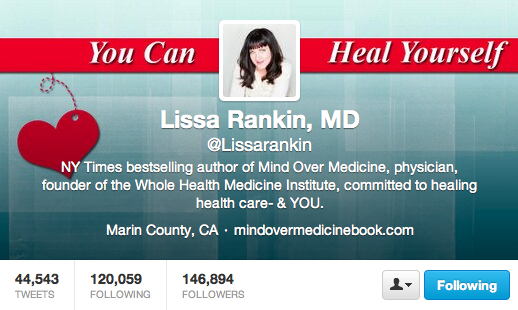
Well, apropos of "science based medicine," I'm looking into this author's book after running across her on Twitter. I've reached out to her. We'll see whether she responds.


Scientific "proof"? We shall see.
Introduction
What if I told you that caring for your body is the least important part of your health . . . that for you to be truly vital, other factors are more important? What if the key to health isn’t just eating a nutritious diet, exercising daily, maintaining a healthy weight, getting eight hours of sleep, taking your vitamins, balancing your hormones, or seeing your doctor for regular checkups?
Certainly, these are all important, even critical, factors to optimizing your health. But what if something else is even more important?
What if you have the power to heal your body just by changing how your mind thinks and feels?
I know it sounds radical, especially coming from a doctor. Trust me, I was just as skeptical when I first discovered the scientific research suggesting that this might be true. Surely, I thought, the health of the human body isn’t as simple as thinking ourselves well or worrying ourselves sick.
Or is it?
A few years ago, after 12 years of conventional medical education and 8 years of clinical practice, I had been thoroughly indoctrinated into the dogmatic principles of evidence-based medicine, which I worshipped like the Bible. I refused to trust anything I couldn’t prove with a randomized, controlled clinical trial. Plus, having been raised by my father, a very conventional physician who made fun of anything New Age, I was as hard-nosed, closed-minded, and cynical as they come.
The medicine I had been trained to practice didn’t support the idea that you can think yourself well or make yourself sick with the power of your thoughts and emotions. Sure, my medical school professors diagnosed some illnesses that lacked biochemical explanations as “all in the patient’s head,” but those patients were promptly and quietly referred to psychiatrists, while eyes were rolled and heads were shaken.
It’s no wonder the notion that the mind might have the power to heal the body would be threatening to many mainstream doctors. After all, we spend a decade learning the tools that supposedly give us mastery over other people’s bodies. We want to believe that the time, money, and energy we’ve put into becoming doctors isn’t wasted. We’re professionally and emotionally invested in the idea that if something breaks down physically, you must seek our expertise. As doctors, we like to believe we know your body better than you do. The whole medical establishment is based on such a notion.
Most people are happy to function within this paradigm. The alternative—that you have more power to heal your own body than you’ve ever imagined—lobs the responsibility for health back into your court, and many people feel like that’s just too much responsibility. It’s much easier to hand over your power and hope someone smarter, wiser, and more experienced can “fix” you.
But what if we’ve got it all wrong? What if, by denying the fact that the body is naturally wired to heal itself and the mind operates this self healing system, we’re actually sabotaging ourselves?
As physicians, things inevitably happen on our watch that science simply can’t explain. Even the most closed-minded doctors witness patients who get well when, by every scientific rationale, they shouldn’t. When we witness such things, we can’t help questioning everything we hold dear in modern medicine. We start to wonder if there is something more mystical at play...
Again, we shall see. The foregoing is from the free sample chapter. A few early yellow flags have popped up, but I don't want to be summarily dismissive.

First place I go any more is to the comments on Amazon. I first look at those with low rankings of any book in question. The "one stars" reviews in this case:
Here is the summary of what this book is trying to state:
1. Have a perfect life. If you don't have a perfect life, seek to make it perfect such as leave a difficult marriage, quit a stressful job, find the perfect partner, and so on.
2. If you don't have a perfect life and have stress you can't get away from then meditate as meditation can neutralise the effects of chronic stress. If you can't meditate, be mindful.
The book is well presented but to me that was all there was to it.
__
I value Lissa's experience AND her work sounds very much like Andrew Weil's and Louise Hay's. If you are familiar with their works, you will find this to be more of the same. There is nothing original here in my opinion.
__
Miserable...is how I felt the entire time I was reading this lousy book - but, I kept soldiering on, waiting for the good part, i.e. Lissa's blinding revelations on how to heal all the dysfunction that is so slavishly laid before us in the first 3/4 of the book. When I got there, all I could do is skim, muttering "Seriously? this is all you've got?"...
__
Then I am sure you will think it is OK... or heck for the real naive in this arena even great as so many seem to have posted.
But the truth is... this is a 'copy-cat' book... in my estimation a very poor knock off... of everything that many others have said many years prior! i.e. Dr. Bernard Siegal - Louise Hay - Dr. Weil - Carolyn Myss - and the list could go on ad infinitum!
If you have ever taken a marketing class one of the first things you learn is... Hey Copy Cat works ... if it worked for someone else... copy it!!!
Then she throws in a bit on her own alleged minimal life disruption... which most of us wish we only had her troubles... She came from an incredibly supportive family... married to quote... the love of her life... and as she also admits has more money than she knows what do with... hard to feel sorry for the disruption she claims she overcame and that all of us should learn something from...
The book was a huge waste of my time and money... a total 'copy-cat' work.
__
The only thing this book proves is that credulous people can be easily conned out of $20 by disingenuous hoaxsters like this fool. No peer-reviewed science, no tested claims, no cogent theories-- just "feel-good" nonsense that provides no real information of value. Save your money. Think twice about believing things that are too good to be true; usually, and in this case for sure, you're being lied to.
__
If you want to read a book loaded with clichés, that all has been written about before, give this a try. But Dr. Lisa just keeps on selling - don't rely on doctors - you can heal yourself, I have the answers - blah, blah, blah. But what about the people who have a genuine positive outlook but unfortunately still die? Did they just not try hard enough? What a message. And, she can't write. But you go, girl - make all your money before being found out to be the vacant yo-yo you are. Am I mad - yep, because I think she is dangerous - really dangerous to people seeking answers. She is no authority - just an old-fashioned shaman.
__
A lot of pseudo-scientific claims with NO peer-reviewed evidence. Real scientists don't use words like "proof". Where's the theory? What variables are being tested? What or who is the control? What journal was this published in? Seriously, anyone who buys this feel-good pseudo-intellectual garbage deserves to be ripped off.

Ouch. The two- and three star comments aren't much more forgiving. When I read too many negative comments / rankings, it's usually a show-stopper for me, given that there are so many books to buy and study.

IN OTHER NEWS

EXECUTIVE SUMMARY: CMS AND ITS CONTRACTORS HAVE ADOPTED FEW PROGRAM INTEGRITY PRACTICES TO ADDRESS VULNERABILITIES IN EHRS OEI-01-11-00571
WHY WE DID THIS STUDY
Electronic health records (EHRs) replace traditional paper medical records with computerized recordkeeping to document and store patient health information. Experts in health information technology caution that EHR technology can make it easier to commit fraud. For example, certain EHR technology features may be used to mask true authorship of the medical record and distort information to inflate health care claims. The transition from paper records to EHRs may present new vulnerabilities and require the Centers for Medicare & Medicaid Services (CMS) and its contractors to adjust their techniques for identifying improper payments and investigating fraud.
HOW WE DID THIS STUDY
We sent an online questionnaire to CMS administrative and program integrity contractors that use EHRs to pay claims, identify improper Medicare payments, and investigate fraud. We also reviewed guidance documents and policies on EHRs and fraud vulnerabilities that CMS and its contractors released for health care providers. Lastly, we reviewed documents on EHRs and Medicare claims that CMS provided to its contractors.
WHAT WE FOUND
CMS and its contractors had adopted few program integrity practices specific to EHRs. Specifically, few contractors were reviewing EHRs differently from paper medical records. In addition, not all contractors reported being able to determine whether a provider had copied language or overdocumented in a medical record. Finally, CMS had provided limited guidance to Medicare contractors on EHR fraud vulnerabilities.
WHAT WE RECOMMEND
Although EHR technology may make it easier to perpetrate fraud, CMS and its contractors have not adjusted their practices for identifying and investigating fraud in EHRs. Our report made two recommendations. First, CMS should provide guidance to its contractors on detecting fraud associated with EHRs. CMS could work with contractors to identify best practices and develop guidance and tools for detecting fraud associated with EHRs. Second, CMS should direct its contractors to use providers’ audit logs. Audit log data distinguish EHRs from paper medical records and could be valuable to CMS’s contractors when reviewing medical records. CMS concurred with our first recommendation and partially concurred with our second recommendation.
PDF link to the full report here. Chart "cloning" and "upcoding" have long been issues. We were aware of such potential all the way back in the DOQ-IT days, 2005-2007.
__

KATRINACARE.GOV UPDATE
Accenture new lead contractor on Obamacare website
By Roberta Rampton and Eric Beech, Reuters
Accenture has been chosen to replace CGI Federal as the lead contractor on the Obamacare enrollment website, which failed to work when it launched in October for millions of Americans shopping for insurance, the U.S. Centers for Medicare and Medicaid Services said on Saturday.
CGI Federal, a subsidiary of CGI Group, built the website, HealthCare.gov, which struggled with error messages and slow speeds for weeks after its launch. The glitches created a political crisis for President Barack Obama, threatening the roll-out of his signature healthcare law and emboldening its foes among Republican lawmakers to call for its repeal.
"As CMS moves forward in our efforts to help consumers access quality, affordable health coverage, we have selected Accenture to become the lead contractor for the HealthCare.gov portal and to prepare for next year's open enrollment period," the agency said in a statement.
CGI Federal said on Friday that its contract, which was originally awarded in 2011 and is scheduled to end February 28, would not be renewed...
Good riddance to these people. I hope they're forced to return the federal money they've wasted.
___

More to come...

Saturday, January 4, 2014

Meaningful Use Stage 2 now fully underway

Well, here we go. Lock and load. If you've spent two or more years in Stage 1, you will now commence with Stage 2 for two years. It shouldn't be all that difficult for you. 

Stage 3 has been pushed back one year, btw.


Click here for the full CMS Stage 2 Guide (pdf).
__

Saw this over at iHealthBeat.org while on holiday vacation.
Concern Grows About Doctor Offices Opting Out of Meaningful Use
Monday, December 23, 2013


Health IT experts say they are concerned that more physician offices will opt out of the meaningful use program, despite the federal government's planned changes to the program's timeline, Modern Healthcare reports (Conn, Modern Healthcare, 12/21)...

According to Modern Healthcare, the penalties for failing to meet Stage 2 requirements of the meaningful use program are minimal, while most of the incentive payments linked to achieving Stage 1 of the program already have been doled out. As a result, there are not significant financial benefits from continuing to participate in the program, according to Modern Healthcare.

Meanwhile, more physicians say they believe that meeting meaningful use program criteria will not result in patient benefits that offset the costs and efforts to achieve such requirements.


Jason Mitchell, director of the American Academy of Family Physicians' Center for Health IT, said that for an average family physician who receives about $100,000 annually in Medicare reimbursements, failing to meet Stage 2 of the meaningful use program in 2014 would cost only about $1,000 in penalties in 2015. The penalties increase to 2% of Medicare reimbursements in 2016 and 3% in 2017, bringing the average family physician's combined three-year penalty to just $6,000.


Mitchell said, "We saw a 17% drop off of meaningful users that engaged in 2011 but didn't in 2012," adding, "I think it's going to be more for 2013" (Modern Healthcare, 12/21).
Probably take a good bit of practice-specific Excel sheet work to model out just where the net wash will be for any one organization -- the cost of upgrades, the workflow revisions, consulting assistance, the very real administrative costs of compliance. Moreover, if you're just getting started in 2014 (Stage 1), your total incentive money potential is significantly reduced.

The relatively easy money has been doled out. And, RECs are essentially going away (a totally stupid idea IMO, even though I'm no longer REC and this blog will soon change its name to The KHIT Blog), so assistance will come at market prices.

Interesting article here, btw, courtesy of my blogger friend John Lynn: One EHR Vendor’s Experience with Meaningful Use Stage 2 Certification.

JANUARY 6TH UPDATE

The latest ONC 2014 Meaningful Use certified EHRs, complete ambulatory systems as of this morning.


47 discrete products, culling the obvious dupes from the paltry 76 presented in the search (e.g., minor upgrade releases to the same basic product). Pretty small cohort relative to the thousands of 2011 certs. Industry shake-out at hand?

Well, there's always Clinic Monkey.


NEWS JUST IN
Senators press for EHR interoperability
House and Senate bills also revisit the HITECH Act
With Congress working on a long-term Medicare “SGR fix” in the recent short-term budget deal, lawmakers laid down seeds for addressing issues such as value-based reimbursement and EHR interoperability.
The House and Senate bills also revisit the HITECH Act. Senators John Thune and Mike Enzi, Republicans from South Dakota and Wyoming, added an amendment requiring “interoperability to be achieved by 2017 to be meaningful user under the Electronic Health Record Meaningful Use program,” with rules established via federal committee under the direction of the HHS Office of the National Coordinator.
John Cornyn, a Republican from Texas, added a more specific and different amendment, directing HHS to adopt a common interoperability standard by 2017, as part of the rules for Meaningful Use Stage 3...
Yeah, the hardy perennial "interoperability" illusion. I've been barking about that for a long time.
___
The year ahead in health IT policy
January 07, 2014 | Anthony Brino
In a new year with a new ONC chief, the federal health IT policy committee is taking comments from the public and its many expert workgroups, and then crafting recommendations for the third phase of the meaningful use program.
With an open public comment period ending January 14, the health IT policy committee and its subcommittees and workgroups covering meaningful use, privacy and security, standards, ACOs and more are scheduled to convene dozens of times now through the end of the year, brainstorming, discussing and then rehashing recommendations on key areas of EHR functions and information exchange.
The first and last health IT policy meetings on the ONC calendar for 2014 are both being held by the Meaningful Use Workgroup, chaired by Paul Tang, MD, chief innovation and technology officer at Sutter Health’s Palo Alto Medical Foundation.
The workgroup is meeting throughout January and February, and on February 4th making a set of recommendations on the issue of meaningful use stage 3 objectives to the full Health IT Policy Committee, which will be chaired by incoming national coordinator Karen DeSalvo, MD..
___

More to come...

Wednesday, January 1, 2014

Happy New Year to everyone in Health IT

Safely back home from eleven days down on the farm in northern Alabama. Long, tiring travel day yesterday, BNA -->  LAS --> OAK. Packed planes ("completely full," as they redundantly say), flight delays at both departures.

Wishing everyone a healthy, happy, and productive 2014. Let's paint the healthcare world a brighter color.
___

More to come...

Thursday, December 26, 2013

Holiday respite


Been a very busy year, as will be 2014, no doubt. But, I'm taking a hiatus of 11 days just eating, sleeping, reading, and thinking while I enjoy family time.

Hope you are are doing the same, and have a great year ahead.
___

More to come, as always...

Wednesday, December 18, 2013

ICD-10: W6142XA, Struck by turkey, initial encounter


Loves me Adobe Suite Photoshop.

From today's post on THCB: Does ICD-10 Pilot Forecast a Perfect Storm for Healthcare?
...The ICD was a tool designed by epidemiologists to get some handle on the prevalence of disease. It was always a blunt instrument, suffering from lack of reliability and of validity of the categories, a lack that was both temporal and geographic. Why anyone could ever imagine that such soft categorizations could be harnessed to capture more than the crudest measure of the experience of illness is baffling. And anyone who imagines that most illness experiences can be parsed into reliable and valid components is deluded into thinking that “health care” can be managed with the same tools that make Sam’s Club and Costco so successful. Stocking cans of vegetables is as concrete as illness narratives are abstract. All we will do trying to codify illness into its components is create cadres of coders and auditors, administrators and regulators, data generators and analyzers, and … so many that we’d be better off letting the inmates run the asylum...

The ACA has much that is noble in intent and much that deserves celebration, not the least of which is universal access regardless of prior illness. But treating health care as a “free market” is delusional: There is no caveat emptor since the patient is insured for much that is unnecessary and is blamed for poor outcomes: If the can of vegetables is spoiled, Costco will replace it, apologize and take the issue up with its supplier. Try that in the US medical system. You’ll end up in a tort.


Unfortunately, I see no way to head off the impending chaos. I see escalating expense, blame and culpability, lay-offs and bankruptcies, all as the price of the billing scheme that drives the implementation of the ACA, a billing scheme that pivots on ICD-10.

There are other approaches that are far more rational and that take the patient and the patient’s experience of illness as the primary raison d’ĂȘtre:


For example:


Maybe such will be the Phoenix.


-Norton M. Hadler, MD
I'm reading Dr. Hadler's latest book The Citizen Patient and will be reviewing it shortly.


apropos, some context from Dr. Hadler regarding medical coding.
By 1970 all the pieces and players were assembled for the American health-care system to become more a cash cow (Figure 3) than a service profession. It has today become a herd of cash cows, particularly in the United States (Figure 4). The seeds of the trend were in the “reasonable cost” clause of the Medicare legislation. No longer was a sliding scale of fees-for-services supporting a cottage industry. The government and large employers were the de facto consumers of services. The compromise with the AMA to permit “usual and customary” fee-for-service charges is embodied today in yet another new age industry dedicated to defining “service” and setting “fee.” In 1966 the AMA first published Current Procedural Terminology (CPT), a set of codes designed to standardize billing for “Evaluation/ Management Services” (E/ M). The CPT Editorial Panel currently meets three times a year and releases new editions each October to reflect changes in practice. The current version lists numerical codes for more than 10,000 procedures and services.

CPT is the most widely utilized medical nomenclature in reports to public and private health-insurance programs in the United States. In 1983 it was mandated for all billing under Medicare and Medicaid. CPT is also a profitable proprietary undertaking for the AMA, which sells all sorts of educational and other aids to assist in the coding exercise. After all, hospitals and physicians need to be able to accurately code for E/ M services or they risk loss of income or fraudulent billing accusations. “Coding” is a burgeoning job category that appeals to many, even to many in the nursing profession. There are courses offered in coding in all sorts of venues, including many junior colleges. Coders are checking on coders, and physicians are admonished if they do not “document” in their records for the sake of coding; they are less likely to be admonished if the content of the record communicates poorly about actual patient care. In fact, coding and billing are driving the design of the Electronic Health Record (EHR) in America. There is no reproducible evidence that the EHR decreases medical errors or increases compliance with “standards” for quality of care. Rather, the purveyance and servicing of EHR has joined coding as yet another profitable industry.

Although the costliness of health care had yet to take off (Figure 4), the inefficiency of paying usual-and-customary fees for each and every coded item was obvious early on, particularly for Medicare and Medicaid patients treated in hospital. It made more sense to pay a lump sum for a particular package of care, a “product” such as a total hysterectomy or an appendectomy. In the 1970s, the Health Care Finance Administration (HCFA), the predecessor agency to the CMS, contracted Robert Fetter, Ph.D., and John Thompson, Ph.D., of Yale’s School of Management and School of Public Health, respectively, to create a classification of such “products.” The result was 467 Disease-Related Groups (DRGs), the last of which was the “ungroupable” category. The intent was to replace cost-based hospital reimbursement with a prospective payment system based on a presumably homogeneous unit of care.

The system was tested in New Jersey between 1980 and 1983, after which it was adopted by the CMS. Many states have since passed legislation requiring the application of DRG-based billing to privately indemnified hospital care. As a prospective payment system, it was designed to provide incentives for efficient and standardized care. If the patient can be treated in hospital for a particular DRG at a cost less than the prospective payment, the hospital can keep the excess. But if the cost exceeds the allotment, the hospital eats it. Given the proliferation of procedures and the complexity of illnesses, the number of DRGs had escalated to 999 by 2007. Much of this relates to provisos for particularly complex or complicated “products.” By hook or by crook, coding was to make sure that the hospital continued to eat well enough to thrive. In 2008 the CMS declared that it would not cover all hospital-acquired conditions, particularly those deemed avoidable. This is a significant stride forward for competent care, since any degree of incompetence leads to codes that change the DRG in a direction that compromises the profitability of the not-for-profit hospital.

The DRG classification takes advantage of an internationally accepted system of disease classification that has its roots in the nineteenth century. The modern version is called the International Statistical Classification of Diseases and Related Health Problems (ICD), which is published by the World Health Organization (WHO) and widely used in the collection of mortality statistics and the like. The ninth edition, the ICD-9, allows for some 17,000 diagnostic categories and is used by the U.S. National Center for Health Statistics, which was instrumental in its development. The ICD-10 has been used since the mid-1990s— but not by the CMS, which adopted it only in the spring of 2013. ICD-10 is a classification system that allows for 155,000 different codes. One can well imagine how the proliferation of ICD codes will beget a proliferation of DRGs. The proliferation of codes is not simply a reflection of the proliferation of disease categories; some of the codes speak to the degree of severity and of complications. ICD-10 coding makes CPT coding look like child’s play. Hence, billing according to DRGs is a monumental task for all involved. Hospitals employ minions to find any nuance that might increase the complexity of the basic DRG in order to increase payment. The CMS outsources this billing to employ minions in the exercise of validating the charge package.

How much should any particular DRG cost? That brings us back to the “usual and customary” and “reasonable cost” roots. The hospital and hospital-supply industries are powerful and spared from most of the pressures of a true free market; they operate with a conspiratorial form of the “free market.” The same consumable or piece of equipment purchased from a laboratory supply house by an NIH-supported research laboratory can cost multiples more when purchased from a hospital supply house. The competition is set at a different level. The same is true for hospitals. Most hospitals will not publish their fee scale for room maintenance, nursing, and hospital services (such as X-rays or the running of operating rooms). Individual hospitals negotiate this fee schedule with individual private insurance companies. The hospital industry negotiates with the CMS, with provisions for the differences in cost in different geographic regions and with the help of lots of solicited and unsolicited “advice.” By law, hospitals must “accept” what the CMS pays even if it is less than their menu of prices for private insurers. Private insurance contracts have no such stipulation. Private insurers pass any bill in excess of the amount charged on to the patient. It’s a cozy arrangement that goes to great lengths to avoid transparency. There are even companies that help patients sort through their bills with the intent of finding overcharges that inflate co-pays. There is absolutely no doubt that this cozy arrangement is part of the explanation for the discrepant curves in Figure 4; the other part is overtreatment in the first place.

The best window into this cozy arrangement is the establishment of physician fees by the CMS. In the early 1990s, the CMS turned to the AMA for assistance with fine-tuning physician fees. This seems a logical extension of the role of the AMA in formulating CPTs. The AMA was to set aside “usual and customary” in favor of a new approach to a fair and accurate valuation of procedures and treatments by physicians. This approach was created by William Hsiao, professor of economics at the Harvard School of Public Health, and his multidisciplinary team of colleagues in the mid-1980s. They formulated and tested their Resource-Based Relative Value Scale (RBRVS) and submitted it to HCFA in 1988. In 1989 President George H. W. Bush signed the Omnibus Budget Reconciliation Act stipulating that the CMS base physician payments on the RBRVS. For every code in CPT, a fee was to be determined based nearly equally on physician experience and practice expense (recently, a dollop more was prorated for malpractice insurance). This is where the input of the AMA was sought. In 1991 the AMA established the Specialty Society RBRVS Update Committee (RUC) to advise the CMS as to the value of physician work and practice expense for the physicians providing any particular management/ evaluation service coded in CPT.

The RUC has twenty-nine members; twenty-three are appointees of major medical and surgical specialty professional societies and three are AMA appointees. All members sign confidentiality agreements before each meeting, which are closed to the public. The task is to calculate the Relative Value Units (RVU) for each CPT. Since the RUC is specialist dominated and heavily weighted to interventionalists, the RVU calculation is biased to value skills gained by lengthy training and the performance of tasks thought to be “stressful.” Cognitive specialties are given short shrift in this calculation. Furthermore, the process values effort over effect, which is contrary to the principles of evidence-based medicine. The incentive is to train to do more, even if the doing is ineffective. There is no incentive to be expert in informing medical decision making, particularly if the informing results in a patient’s desire to forego something with a high RVU. There is no incentive for higher quality performance or for caring for the more severely afflicted. RVUs are a perverse measure.

As is true of most areas of administration of the American health-care system, there is little transparency in the machinations that influence the CMS. That means there is little public debate. However, there is debate and controversy among the cognoscenti. The primary-care physicians who are not well represented on the RUC (except for the current AMA-appointed chair) and the cognitive specialists who are in the minority are crying foul. They want to be better valued. I am crying foul because this is an example of a public regulatory agency being controlled by the interests it is meant to regulate. The economists call this regulatory capture. I call it corrupt.


Hadler, M.D. Nortin M. (2013-04-01). Citizen Patient (H. Eugene and Lillian Youngs Lehman Series) (pp. 63-68). The University of North Carolina Press. Kindle Edition.
There is no reproducible evidence that the EHR decreases medical errors or increases compliance with “standards” for quality of care. Rather, the purveyance and servicing of EHR has joined coding as yet another profitable industry."

Well...We could relatively easily study the former assertion, but, doing so would not be cheap.

DECEMBER 19TH BREAKING NEWS

From: Sebelius, Kathleen (HHS/OS)
Sent: Thursday, December 19, 2013 11:19 AM
Subject: Important Staff Announcement

Colleagues,

I would like to announce that Dr. Karen DeSalvo, who currently serves as the City of New Orleans Health Commissioner and Senior Health Policy Advisor to Mayor Mitch Landrieu, will be the next National Coordinator for Health Information Technology here at the Department.

During her tenure, Dr. DeSalvo has been at the forefront of efforts to modernize the New Orleans health care system. Following Hurricane Katrina, for example, she led projects to increase access to care by augmenting the city’s neighborhood-based medical homes for low income, uninsured and other vulnerable populations in the New Orleans area.

Throughout her career, Dr. DeSalvo has advocated increasing the use of health information technology (HIT) to improve access to care, the quality of care, and overall population health outcomes –including efforts post-Katrina to redesign of the health system with HIT as a foundational element. She served as President of the Louisiana Health Care Quality Forum, the Louisiana lead for their health information exchange and regional extension center grants. She has also served as a member of the Steering Committee for the Crescent City Beacon Community grant.

As the New Orleans Health Commissioner she has made the increased utilization of HIT a cornerstone of the city’s primary care efforts and a key part of the city’s policy development, public health initiatives and emergency preparedness. Further, she has led the planning and construction of the city’s newest public hospital, which will have a fully-integrated HIT network. Her work as commissioner has led to positive changes to the way healthcare providers deliver care to their patients, improved accessibility and outcomes for patients, and improved the health of all New Orleanians. Dr. DeSalvo is a graduate of Suffolk University, Tulane Schools of Medicine and Public Health, Harvard School of Public Health.

Dr. DeSalvo’s hands-on experience with health delivery system reform and HIT and its potential to improve health care and public health will be invaluable assets to the Office of the National Coordinator and the Department. I would also like to take this opportunity to thank Dr. Jacob Reider, the Acting National Coordinator for his leadership of ONC during this time of transition. I am pleased she is joining our committed team, and ask you to join me in welcoming her to HHS when she starts on Monday, January 13th.

Sincerely,
 
Kathleen Sebelius
That's pretty interesting. I certainly wish her well.___

More to come...